
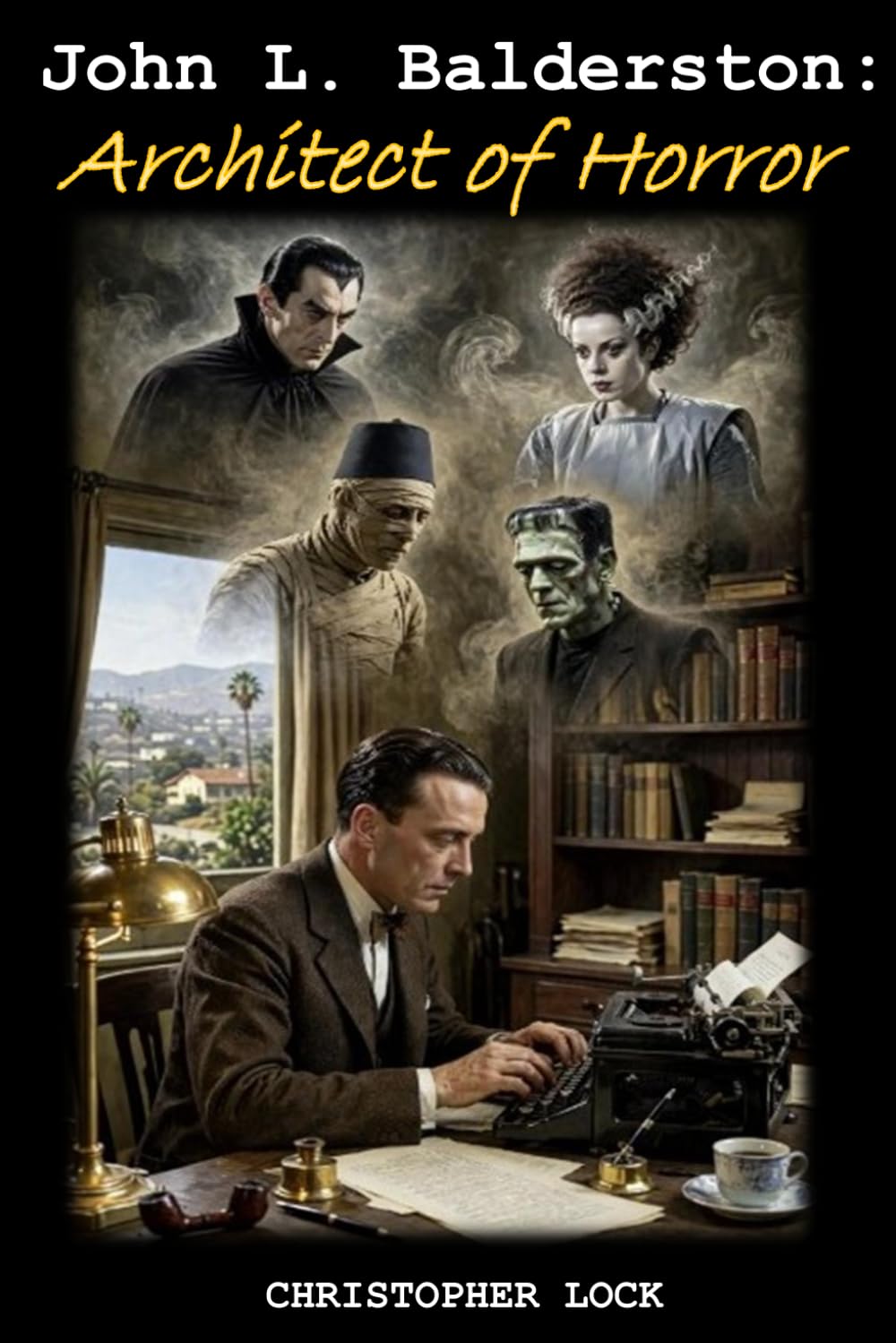
John L. Balderston: Architect of Horror
Published by Centerline Publishing, 2026. 205 pages.
By Christopher Lock
Being an avid collector of non-fiction books on the horror genre, and being a fan of the Universal films, anytime I see a book on the subject, I add it to my library. Whether it be on director James Whale, any of the actors associated with those films, such as Boris Karloff or Bela Lugosi, to the makeup man Jack Pierce, to even Kenneth Strickfaden who created all the electronic equipment in the Frankenstein films, if someone wrote it, I’ll get it. But one subject associated with that part of our horror history is screenwriter John L. Balderston. He’s always mentioned in a lot of these books, but that’s just it. Nothing has been written solely on this essential part of those films. Until now.
Author Christopher Lock, has written several books on these Universal films, including one on The Bride of Frankenstein, which I reviewed HERE, so he definitely knows the subject, and you can tell has done some extensive research on the subjects. While Balderston technically was only involved in a handful of classic titles, and always a contributing writer instead of having full ownership of the script, we still get to read a lot of information about him, how he got started in the industry, not to mention what he was doing before and after.
At the beginning of what would become the reign of horror from Universal, Lock writes, “The Gothic had to become cinema, and Balderston was one of the writers who made that transformation possible. His particular gift was to understand that the most frightening monster is rarely frightening simply because it is monstrous.” This really shows us that Balderston was putting his footprint into these scripts, showing that there is more depth into the monstrous character than at face value, which I think is one of the reasons for their lasting impact.
Lock also points out that nowhere within these pages is he claiming the success is solely on Balderston’s shoulders, but because of his experience, like Henry Frankenstein, he was able to add in certain elements, or parts, to help give the character more life. Balderston “understood how to dramatically humanize the impossible. He could take a supernatural premise and give it emotional logic. He could take a literary monster and turn it into a cinematic character. He could reduce a sprawling Gothic narrative to a manageable dramatic conflict without necessarily destroying its essential theme.”
If you’re looking for a ton of details about the making of the titles he was involved with, such as Dracula, Frankenstein, or The Mummy, there is some of that here. But remember, the focus of this is on Balderston, so there is a lot of information on his work as a journalist, eventually working as a war correspondent, as well as reporting on events really from around the world. After exclusive news coverage was sold to only one newspaper, Balderston helped fight to have everyone included in the news, as covered a lot of what was going on at the time of the discovery. The book also shows us that even while working as a reporter, he was also trying his hand at writing for the theater and having some pretty good success at it too!
This book only runs a little over 200 pages, but it still gives the readers a fascinating insight to a person that most horror fans were just aware of his name because we’d see it show up in the credits in these classic Universal films. Now you have the chance to learn a little more, and to see just how talented, and how much of a wide range of talent John Balderston had.

