
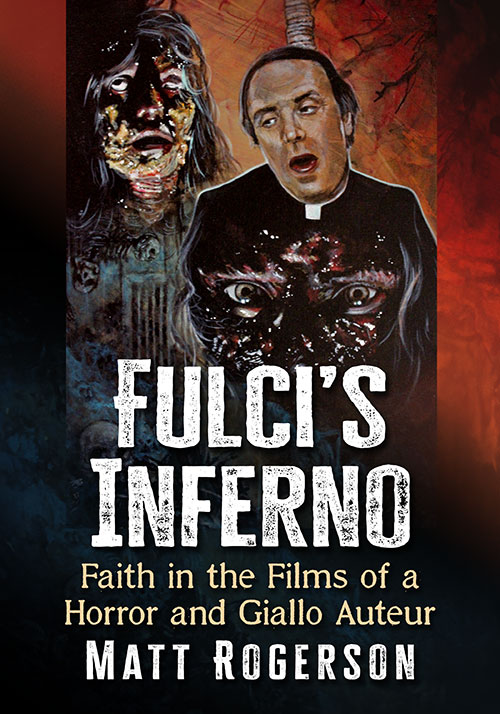
Fulci’s Inferno: Faith in the Films of a Horror and Giallo Auteur
Published by McFarland, 2025. 257 pages.
By Matt Rogerson
Anytime I see a book dedicated to Lucio Fulci and his work, I’m immediately in, which was the case for this book from Rogerson. That’s mainly because there isn’t a ton of work on him, which is very sad. I will say this work is more in the “academic study” style, which for me at least, were usually a little too “out there”, with lots of theories as to what the filmmaker really meant, at least according to the authors. But I’ve found that as I’ve gotten older is that while I may still not agree with what the author is saying, and that’s with any author, I really now do enjoy reading about these different ideas or theories and just thinking about them. Doesn’t mean I’m going to agree with them, but I love the fact that it gets your mind pondering different ideas and maybe thinking about a particular film, or even a single scene in the movie in a way you didn’t before.
The real beauty of Rogerson’s book here is that not only do you get those kinds of nuggets of ideas, but there is a lot of factual information about Fulci, and especially his earlier work that I bet most Fulci fans were not aware of. I know that was the case for me. Most horror fans know about Fulci and his penchant for gore and horror and really think that is all that he had accomplished in his career. Rogerson gives his readers plenty of information about Fulci’s early work, as what he was seeming to say with his films, especially towards the Vatican. Not to mention the fact that Lucio Fulci was a very talented filmmaker, who was much more talented than you see in the films at the end of his life, and we can understand a little more as to why.
Some film fans might not be aware of some of the policies and controls that the Vatican put into place to “guide” their flock. As stated early in the book, Rogerson writes, “The Church saw the power of cinema as a tool of social communication and education but recognized the need to strictly control it to avoid planting ideas in the public consciousness that were at odds with the Church’s morals.” In other words, anything that went against their beliefs would not only get their negative comments but would tell their followers not to see these films. Of course, we learn that even back then, Fulci knew how to manipulate the system.
In his film Beatrice Cenci (1969), which is based on a true story about a young woman who murders her father after a lifetime of abuse. She is then executed for her crimes, and the Church, for all their hard work in bringing this murderer to justice, takes of the land and money from the family, something the church has done for centuries. So, knowing the story of this new project would not get approval from the censors and producers, Fulci had written two different scripts, the one they were going to read and approved, and the one he would eventually make. Of course, once it was release, the Vatican was outraged and condemned the film, as well as the director. They did not like the fact that Fulci’s films were digging into the Vatican and showing their hypocrisy.
My favorite part of the book is really the beginning, learning about Fulci’s start into the film business, learning of the tragedy of his real life, the death of his wife, and other things that really developed his way of filmmaking. It had me not only thinking about those early films but realizing that it really was molding him into the filmmaker he would become in the ’80s and to the end of his career/life. Things made a little more sense.
But the main part of the book is on what the author calls Fulci’s Triptych of Terror, which includes City of the Living Dead (1980), The Beyond (1981), and House by the Cemetery (1981). This is where we get to the part where the author has a theory and tries to prove his point on how these three films are connected. Again, I really enjoyed some of the points, some being very valid, that Rogerson makes and it made me really putting a lot of thought into them. But when we got to House by the Cemetery, and Rogerson mentions that young Bob could actually be Dr. Freudstein and the film resides in time loop, I had to stopped with a puzzled look on my face. But after you get past the immediate “that’s just crazy” and think about it a little, while you still might not agree, you can definitely see where the idea can hold at least a little bit of water, especially with the closing quotes about all children are monsters. And that is why I really enjoyed this book.
Rogerson also points out the impact that the different screenwriters Fulci worked with had, specifically Dardano Sacchetti, who wrote the films in the Triptych of Terror, plus a few others in Fuli’s filmography. I liked the fact that he takes the time to point that out, since sometimes screenwriters don’t get the credit they deserve. But Sacchetti also gave a lot of praise to Fulci as well, saying he always knew how he wanted to film the different sequences while reading the script.
After the discussion of this trilogy, he does cover some of the later day Fulci films and tries trying up some connections to this same theory. Again, it is some interesting reading and does make you wonder a bit.
In the intro, Rogerson states, “Fulci married transgressive gore with arthouse sensibilities in his cult classic horror films in a way not seen before, disassembling the traditional narrative signposting while pushing the boundaries of taste and decency at the same time.” In the rest of the book, Rogerson makes plenty of valid statements to help quantify them, as well as some very interesting ideas to make you think about a lot of ideas of the director’s work that you might not have thought about. Again, it’s not about if it is an opinion or fact, but that it makes you ponder those ideas. And at the end of the day, that is what any book, academic study or simple review guide should hope the reader does with it.
 kitleyskrypt.com
Going on my list!
LikeLiked by 1 person
Thank you for your very thoughtful and considered review of my book! I’m so happy that you enjoyed my musings- Matt R
LikeLiked by 1 person
My pleasure! Thank you for putting that out in the world!
LikeLike