
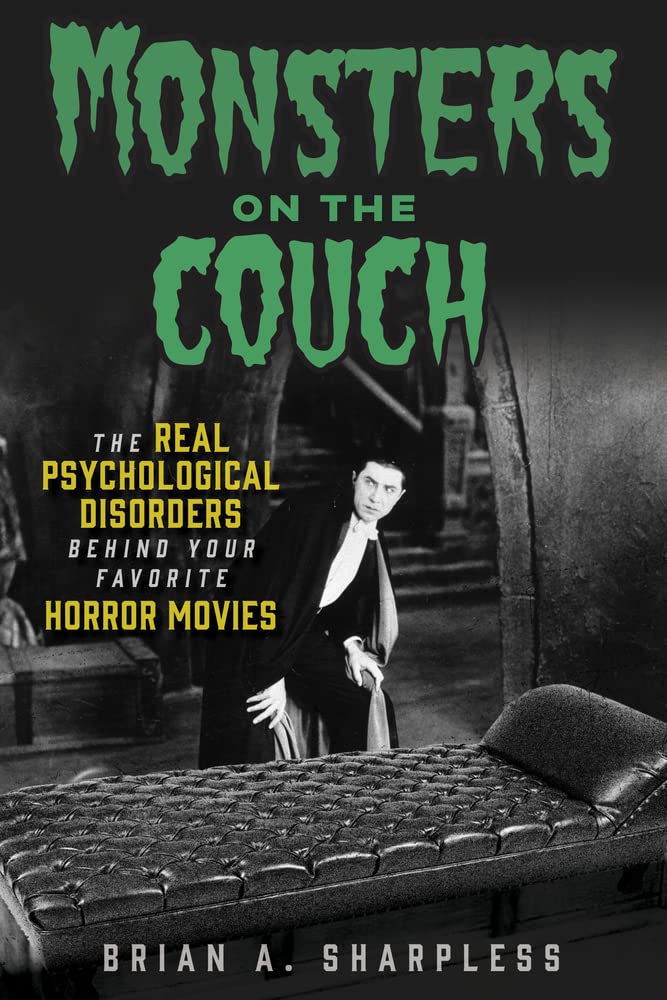
Monsters on the Couch: The Real Psychological Disorders Behind Your Favorite Horror Movies
Published by Chicago Review Press, 2024. 274 pages.
By Brian A. Sharpless
When I started reading this title, I thought it would be a look at specific movie titles and putting them through a psychological profile or study of the monster. It’s kind of is that, but not really specific movies, though there are a few. It mainly covers the different real-life psychological disorders that plague some people, that are tied into different horror sub-genres. Granted, some of these disorders are pretty rare, but honestly, some of them are pretty damn fascination.
We get to read about the history of lycanthropy, going back to folklore hundreds of years before we saw them on the big screen. Did you know that in Serbia, it is believed that if you drink water that has collected in the paw print of a wolf, you can become a werewolf? Or in Scandinavia, you’ll get the curse by wearing a wolfskin belt. Or there are many different kinds of ‘anthropy’, from turning into a horse, cow, or even a gerbil! It is kind of cool to see where it started, and how it… transformed into what we know about werewolf legends and mythology now because of film. Once the movie world gets a hold of it, those almost becomes the new “facts”, even though 90% of them came from some screenwriter’s imagination.
When we get to the next chapter, on vampires, we get to read about the historical folklore as well as certain “legends” associated with vampires and blood-drinkers. We learn about clinical vampirism, or what is also referred to as Renfield’s syndrome. Author Sharpless does go into detail on the diagnosis part as well as treatment but does a great job not only explaining it in layman’s terms but showing just how difficult both of those can be.
I know we all love zombie films, but I had no idea there is a condition, called Cotard’s Syndrome, where a person feels that they are either already dead or dying, and are slowly rotting away. Granted, even though the person is not actually dead, or having organs failing, that is what the person is convinced is happening. Or digging into the whole subject of cannibalism. How’s that for a tasty subject matter?
The rest of the book is same, opening up my mind to the countless other disorders out there in the world. From being convinced your partner has been replaced by an exact double, to being haunted in your sleep by a Dab Tsog or maybe a demon, there’s a lot out there to wrap your brain around. Granted, as I mentioned earlier, a lot of these cases are very rare. But the fact that there is some, and enough to have a name created, is pretty fascinating. Strange and bizarre, but still fascinating. I mean, who knew there were so many different variations on necrophilia? You have tactile to fetishistic to romantic to opportunistic to even necromutilomaniacs. Once again, it just shows how strange and fascinating the brain can work, and how off the beaten path one can venture.
So, if you have any interests in learning about some of these strange real-life disorders that can be tied to a lot of different horror and monster sub-genres, and probably learn more than you need to, I found this book to be really engaging and many times just made me realize how intricate the human mind is, and where it can go. May make you look at zombie films or even Freddy Krueger a little differently.

