
Directed by John Carpenter
Starring Sam Neill, Jürgen Prochnow, Julie Carmen, David Warner, John Glover, Charleton Heston, Peter Jason, Frances Bey, Bernie Casey, Wilhelm von Homburg
There have been many, many film adaptations of the works of H.P. Lovecraft, in both short films and feature-length ones. The first one was from Roger Corman, with his 1964 feature The Haunted Palace. It was titled after a poem from Edgar Allan Poe, to keep in line with the rest of the Corman/Poe cycle, but the story itself is entirely based on Lovecraft’s The Strange Case of Charles Dexter Ward, which didn’t get published until after the author’s death. While some films have come sort of close to the original tales, I would say that very few have really captured the essence of Lovecraft’s work. Describing things so terrifying, so strange and weird, that if one was to actually see it, you’d simply go mad. He wrote about things beyond our human comprehension.

Then we get to this film by Carpenter, which is not based directly on a specific Lovecraft story, but I feel has more of the feel of the author’s work than any I’ve seen before. Almost like writer Michael De Luca was weaving Lovecraft into the very words of the screenplay.
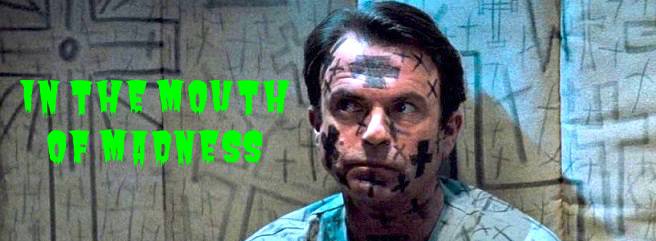
The film starts off with Sam Neill’s character John Trent, arriving at some sort of institute for the insane. Dr. Wrenn, played by the stellar character actor David Warner, shows up to talk to him to see if he is actually crazy. With crosses covering his outfit that he’s drawn on, as well as all over his padded cell, he starts to try and explain the impossible to the good doctor.
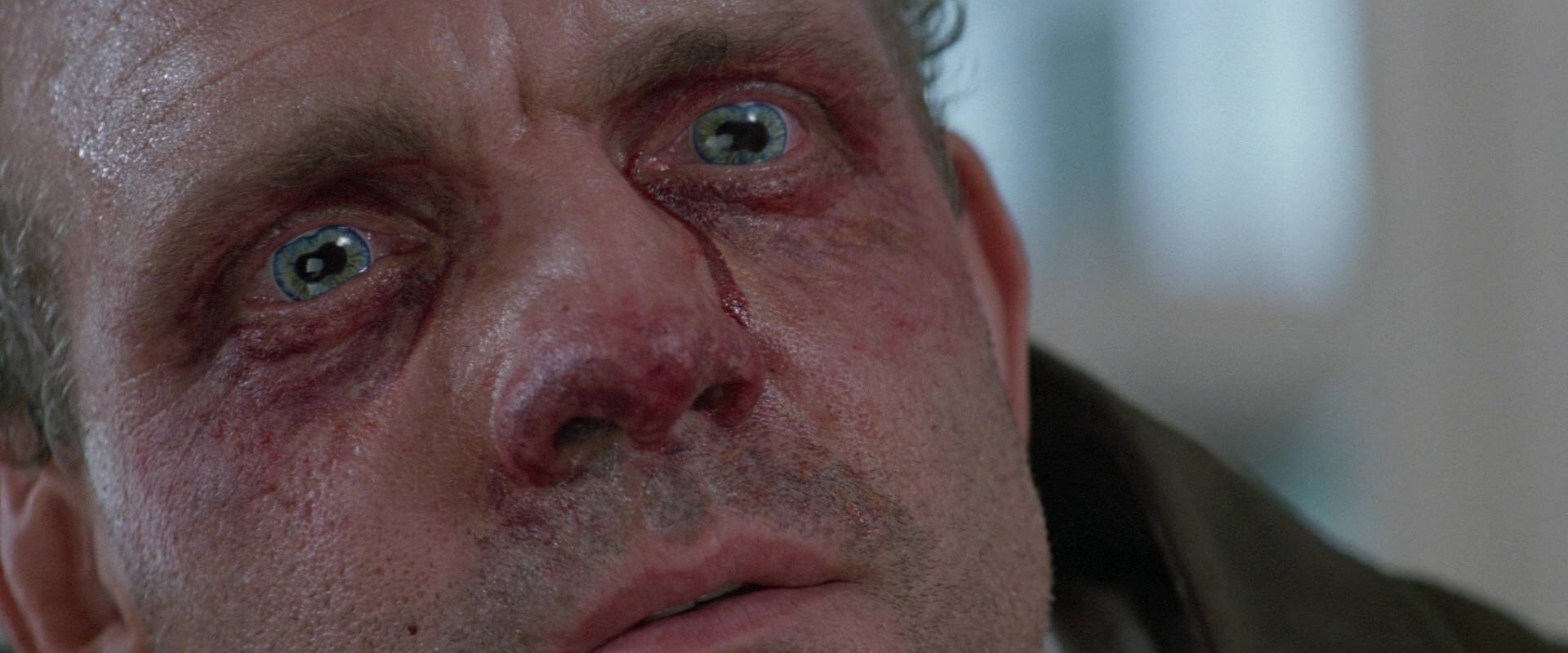
Trent is an independent insurance investigator, the best in the business, who is hired by the publishing company who handles the work of Sutter Cane. He’s an author whose work is said to affect some of his more weak-minded readers, and not in a good way. When there is a delay on the new book, riots even break out at local bookstores. The delay is because Cane seems to have disappeared, and Trent is hired to find him. He immediately thinks it is just a big publicity stunt to pump sales. He heads out to find the “fictional” town of Hobb’s End, a town Cane uses in his novels, along with Linda Styles, Cane’s editor, played by the wonderful Julie Carmen. When they suddenly arrive at the small town, Trent is still convinced that it’s a big PR stunt. But he slowly starts to realize that somethings just don’t make sense. Such as the painting in the hotel that they are staying at, where the images in the painting seem to keep moving.
Sam Neill does an incredible job as the guy that nobody can pull a fast one on, that slowly starts to lose his mind. There are a few of Carpenter’s usual suspects here in small roles, such as Peter Jason, but also ones like Bernie Casey, Frances Bay, John Glover, and even Charlton Heston. Cane is played by German actor Jürgen Prochnow, who does an exceptional job. He’s not onscreen a lot, but when he is, he makes the most of it. But it is Neill who the audience follows along, wondering if we’re going crazy along with Trent. Are we to believe what we’re seeing as well, or is this in fact, just part of a story written by Cane?

Carpenter follows Lovecraft’s way of showing you glimpses of things, just enough to make you realize you’ve seen something terrifying, but not really sure what it was. He also gives us a brilliant way of showing how “reality is not what it used to be”, as one character says. When Trent realizes that he actually may not be in control of his actions, and that he is in fact, just a character in a story, it really could drive you mad.
This new 4K release from Arrow looks sharp, clear, and just amazing. And even better is the number of extras on this release. There are two different archive audio commentaries, one with Carpenter and producer Sandy King Carpenter, another one with Carpenter and DP Gary B. Kibbe. But then there is a brand new one with filmmakers Rebekah McKendry and Elric Kane, co-hosts of Colors of the Dark podcasts. There are also new interviews with producer Sandy King Carpenter, as well as with actor Jürgen Prochnow, as well as archival interviews with Julie Carman and makeup effects artist Greg Nicotero.
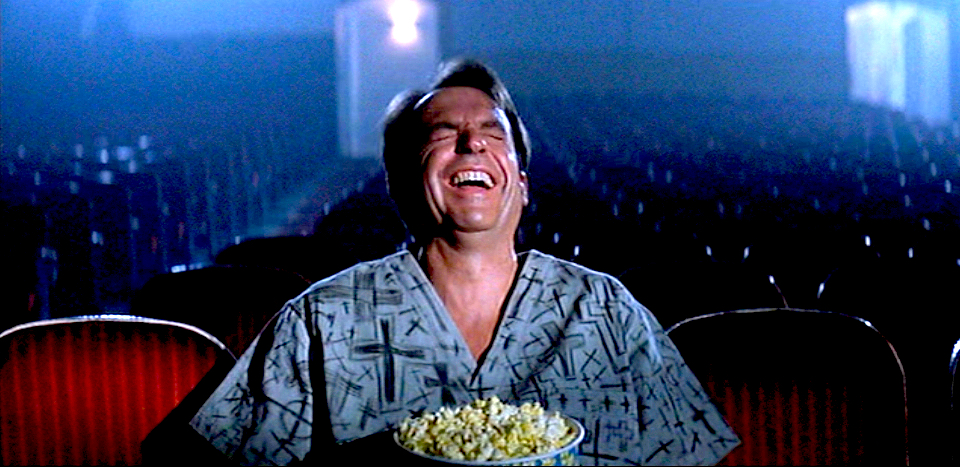
There are also a couple of new featurettes, one called We Are What He Writes, which is about Carpenter and the film, and one called Reality Is Not What It Used to Be, an appreciation by film scholar Alexandra Heller-Nicholas. Add a couple of archival featurettes and behind-the-scenes stuff, and you’ve got one hell of a release here.
I would say this is probably the last, great film that Carpenter made, and it still holds up. This new release is a great way to see the film all over again and realize just how damn good and smart the film is.
 kitleyskrypt.com