
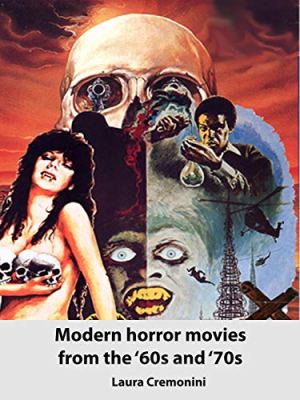
 Modern Horror Movies from the ’60s and ’70s
Self Published, 2019. 197 pages
By Laura Cremonini
Because I wanted to give this author a chance by looking at more than just one of her books, I purchased a second title, and I was happy to discover that it seems that this is actually original text and not lifted from any internet source. Or at least, not that I could find. What I did find though was something more interesting. It doesn’t seem she has improved on the formatting here, since some of the movie titles are in quotes and some are italicized. So on par with the previous book I reviewed, she is desperate need of a good editor.
The real strange part of this book is that she has decided to take on a particular slice of the horror genre, from the ’60s and ’70s, reviewing certain titles, which really is just stating the plot and then giving the reader’s a Catholic evaluation. What her affiliation with the Church is not known, so I’m assuming she is a devote follower that is giving us her interpretation of what the film means or represents to her. Sounds fair enough, since I’m always looking for different opinions on films.
Though… it doesn’t help when there are few errors or inconsistencies throughout the book. For example, she makes the comment that “Until 1962, horror movies produced by Hammer were directly exclusively by (Terence) Fisher.” Yes, while all of their major titles were directed by Fisher, there were more than a titles not directed by him, such as the first two Quatermass films by Val Guest, Taste of Fear by Seth Holt, The Shadow of the Cat by John Gilling, and a few more. Yes, this is just me being picky, but it does point out the lack of research to make such a claim.
When writing about George Romero’s Day of the Dead (1985), she writes “Set in a world dominated by zombies, we find a handful of human beings on an island who try to tame one and find a solution to the epidemic. The movie, which boasts very strong gore effects, turns out to be lackluster copy of Dawn of the Dead.” Okay, first of all, if this book is Modern Horror Films of the ’60s and ’70s, why is this title even mentioned? More on that later. The fact the she couldn’t tell the film does NOT take place on an island, makes me wonder how she could tell that it is a “lackluster copy of Dawn of the Dead.”
Here is where the real problems came for me. We all have our own opinions and are entitled as such. But some of the comments she makes seem to even contradict herself, even in the same sentence. In Richard Donner’s 1976 film The Omen, she writes that it “is a good horror movie, well directed, with no particular merit.” So is it good or not?
According to the author, Tobe Hooper’s Texas Chain Saw Massacre (1974), is “a real cult movie that tells the cruel destiny of a group of guys who come across a family of crazed assassins in the American countryside. Through the years the movie has been considered a cursed and extremely scary movie.”
Assassins? And a group of guys? What happened to the two female leads? In one part of the book, she calls Chain Saw a “good movie” saying he created a “family universe that is completely deviant.” Sounds fair. But later on, when giving her Catholic evaluation, she calls it “monotonous and obsessing”, going on to say that it’s “not plausible and the lack of significant psychological or social justifications behind it lead us to consider it as atrocious, imagined and made for abnormal people to definitely throw them into the abyss of inhumanity.” Right. But at least she did call it a “good movie”, so I guess that’s something, right?
It seems that Cremonini is not sure what her feelings are for these movies. Continuing with Hooper, she writes “In 1982, having noticed this growing talent, Steven Spielberg made him direct a great and successful movie called Poltergeist.” While there is that eternal debate on who really directed the film, she even states “Despite its success, to this day malicious people claim that Spielberg’s contribution to the direction of the movie is bigger than Hooper’s. It is true that in this case the visual style is much more similar to Spielberg’s than Hooper’s violent and brutal style.” So first she says that “malicious people” state that claim, but then agrees the style is more Spielberg than Hooper. Plus, I love the fact that Spielberg made Hooper direct it!
It makes me wonder why write a book about movies that you find no interests in, or find disgusting and terrible. Is it to get people not to watch them? When she is discussing Hammer Films, she states Curse of Frankenstein is “of little interests and the acting is altogether conventional.” Wait… it gets worse, because she really takes a bite out of Horror of Dracula when she writes “It is uncommon to see such an array of horrible things, disgusting scenes, sadism and superstition in just one movie. The atmosphere is morbid and not even the obvious ingenuousness and the absurdity of the situation can mitigate it.”
So why even bother with it? And again, these films came out in the late ’50s, so why are they even covered? In fact, there are multiple titles covered here that don’t fit under the book’s moniker, such as Michelle Soavi’s The Sect (1991), William Friedkin’s The Guardian (1990), Cronenberg’s The Fly (1986), that get reviewed like the rest.
Another conundrum is that with all this moral religious evaluations and condemnations, filled with horrible and sadistic things, then why is the book filled with pages and pages of nude scenes from the different movies? I’m not talking about a shot here and there either. While writing about Hammer’s Twins of Evil (1971), she says it “indulges in the usual sex and sadistic orgies which are typical of some horror movies”, but then follows it with 3 pages of nude scenes from the movie. Same with Lust for a Vampire (1971) and Demons of the Mind (1972). Again, what point are you trying to make here? That these films are bad for the viewer because of the sex and violence, but it is okay for you to use gratuitous nude shots from the films?
I’m really not sure what the author was trying to do here. At some points, it sure seems like she’s trying to condemn the genre as a whole, but then states every now and then there are good films in there, only then to try to downplay them again. Very confusing. Even at only $10, I feel that you’re better off putting that money towards something a little more straight forward in its message and a little less wishy-washy.
 kitleyskrypt.com
It just goes to show…
Anyone can write a book.
Not everyone can write a good book.
And some people aren’t even trying.
Thanks for taking one for the team, champ.
LikeLiked by 1 person
That’s what I’m here for!
LikeLike