
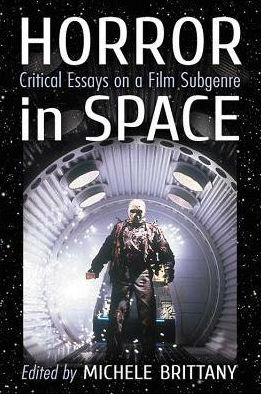
 Horror in Space
Published by McFarland, 2018. 248 pages.
Edited by Michele Brittany
The book’s subtitle is “Critical Essays on a Film Subgenre” and boy howdy, it sure is. If you’re looking for an easy read, one that might bring up some easy but not-too-deep thinking ideas about these movies that we love, then you might want to look for another book. When you have the words “Critical Essays” in the book’s title, that is a big hint at the kind of writing that you’ll find within those pages. The collection of authors that have been gathered here for this volume are all very intelligent scholars, from sociology teachers, doctoral candidates, to professors, so they know their stuff. So please don’t let my comments about their opinions and theories seem like I’m trying to say they are uneducated. That is not the point I’m trying to make.
Like a lot of these theory essay books, I’d make a guess that some of these are from a collage thesis or part of a future book. But I still stand by my own theory that sometimes a duck is just a duck. I know there are some films where the creators are weaving different subtext within the story, such as any version of Invasion of the Body Snatchers. But I feel a lot of these scholars take a subject matter and form into something that then fits a particular movie or sub-genre.
In Dario Altobelli’s essay The Cold, White Reproduction of the Same: A New Hypothesis About John Carpenter’s The Thing, he states “The Thing and other science fiction horror films in which the alien has metamorphic abilities can ultimately be read as powerful metaphors of capitalism.” I will agree that they can be read as a metaphor…just don’t think that is what the filmmakers were trying to say. Or at least not to that extreme. According to Carpenter, The Thing came down to basic theme of “losing your humanity and losing humanness. The ‘thing’ can stand for anything: It can stand for greed, for jealousy, for any of that kind of cliché evils that human beings are totally prying to.” So while the capitalism suit might fit, I don’t think that was the one Carpenter designed. Again, my opinion.
I do love reading these different ideas about these films because I do think it is a great way to make the reader think of it maybe in a different way than before. I enjoy that pondering. Does it change the way I think of the movie, in the way they think it means? Usually not. Most of the time it just puts a smile on my face and shake my head. But it does make me think of the concept or idea of it.
In Meteor Madness: Lovecraftian Horror and Consumerism in the Battle for Small Town USA, author Nicholas Diak writes about a bunch of different movies where the threat comes from a meteor or something coming from space besides a spaceship. I do have to give him props for bringing to light that is actually a sub-genre! But when he’s discussing The Blob (1958), he talks about the fact that since the title terror consumes people, meaning eats and absorbs them, it must be a reference to consumerism. He writes “…all of these creatures and cosmic conditions are agents of consumption: they eat, absorb and grow larger while negatively impacting the environment. In essence, they become physical embodiments of consumerist philosophy.” Great way to tie those together, but I feel that when the creators of this movie were trying to come up with a different kind of movie monster to be a box office smash, trying to tie it in with a hidden subtext of consumerism was probably not on their agenda. Once again, I could be wrong. The fact that it attacks a diner or grocery store has more to do with the story, needing a freezer to show a specific plot point, and not to show any connection with where things are consumed.
Even with all these seemingly connected theories, I did find myself enjoying them. In Kevin Chabot’s essay on Leprechaun 4: In Space (1996), I found myself actually wanting to watch the movie since I had never ventured that far into that particular series. And when he discusses Jason X, that definitely made me want to revisit that title as well. My point is that even if you might not agree with what the author is saying, if it makes you want to re-watch a title or seek one out, then I think that is a positive effect, no matter what.
I also found Andrew P. Williams essay, Betwixt and Between: Magic, Science and the Devil’s Place in Outer Space, another interesting take on films dealing with more of supernatural element, even when it is in the deep darkness of outer space.
So even if you’re not going to agree with some of, or all of the points these different authors are trying to make, or the connections they feel are there, if you can at least read through them with an open mind, you might at least see a different point of view, which then could make you think or see the film in a different way. Again, doesn’t mean you have to buy it, but at least understand it. After all, isn’t that what discussing film should be about?
This title can be ordered from McFarland from their website www.mcfarlandbooks.com.
 kitleyskrypt.com