Book Review: Making and Remaking Horror in the 1970s and 2000s

making and remaking horrorMaking and Remaking Horror in the 1970s and 2000s By David Roche Published by University Press of Mississippi, 2014. 335 pages.

Sometimes I really regret asking for a book to review. Especially when I had just finished reviewing one epic size book of Psycho-Babble, and then along comes this relatively new book by David Roche. He is a professor at the Université Toulouse Le Mirail with some publishing credentials under his belt. In other words, he’s no slouch. In fact, Roche is a very smart man and can do some amazing fact finding research, which he puts to use in this book. The concept of the book is to try and figure out the differences between the original ’70s versions of Texas Chain Saw Massacre, Dawn of the Dead, Hills Have Eyes, and Halloween, and their remakes that were all made in the 2000s, or what makes them better or worse and for what reasons.

That initial concept is what intrigued me at the start. But once I dove into it, I quickly realized what I had gotten myself into once again. This is not written for the casual fan, but for a very academic crowd. In fact, I had a dictionary opened most of the time when I was reading it to make sure I was getting the point he was stating. Gotta say though…even that didn’t help a lot of times. These University style books love to go way out of their way to explain something about a movie that really doesn’t need it or even have an explanation other than what is at face value. Here, Roche does a lot of quoting from other works of this sort, as well as giving his own insight, which I frankly think all of which is putting way too thought on this stuff.  Let me give you a couple of examples.

Continue reading

Book Review: The Horror of it All

horrorofitallI first met Adam Rockoff in 2008 at a Fangoria Weekend of Horrors in Chicago. He was going to be there to help run one of the Q&A panels that was going to be in the evening at the Music Box Theatre. I knew of Adam because of his book Going to Pieces: The Rise and Fall of the Slasher Film, which was later adapted for the documentary of the same name, both of which are worth your time. So I was actually excited to meet him and have him sign my copy of his book that I had brought, which he graciously did once we did finally meet. Which in fact, was rather funny since I had no idea what this guy looked like. So when he came up to my table and started looking through the books I was selling, talking about different reference books, and then casually mentioning that he had written a book. Once he told me his name, I told him that myself and friend Aaron Christensen were the ones he was suppose to meet up with for the Q&A panel later. Small world. From that moment on, we became good friends. He’s been over the Krypt several times for some movie screenings and other get-togethers.

Continue reading

Book Review: The Films of Larry Buchanan

filmsofbuchananThe Films of Larry Buchanan
By Rob Craig
Published by McFarland & Company, 2007. 271 pages.

While the films of Larry Buchanan might be an acquired taste, he is probably my favorite of the low (or no) budget filmmakers. And hearing stories about his films and the making of them are sometimes more entertaining then the movies themselves.

Author Craig does an amazing job dissecting Buchanan’s film, giving us a ton of information about the films, the people who worked on them, and Buchanan himself. The only problem is that I think Craig has looked at the films at little too close and started to see things and meanings that I don’t necessarily believe are there. Now granted, with any film study, there are those who see deeper into the pictures than others can. That is not to say they are right or wrong, but for me I think if you stare and examine anything long enough, you will find whatever it is you might be looking for. As much as I love and enjoy Buchanan and his films, I don’t think some of these deeper messages that Craig points out were really there or at least never consciously intended to be there. Again, this is just MY opinion.

Continue reading

Book Review: It Came From Hunger! Tales of a Schlockmeister

hungerbookIT CAME FROM HUNGER!  TALES OF A SCHLOCKMEISTER
By Larry Buchanan
Published by McFarland & Co, 1996.  215 pages.

For those out there that think that Roger Corman made movies with incredibly low budgets, then you need to learn who Larry Buchanan was.  Station out of Texas, Buchanan churn out film after film with embarrassing low budgets, some of them making some decent money.  This is one of my favorite quotes from the book:

“Roger Corman had been giving three times the budget we had.  His version was in black and white, and he had as his leads Peter Graves, Beverly Garland, and Lee Van Cleef.  And the running time was only 71 minutes.  For $30,000, I was expected to shoot 80 cut minutes of color and bring in three young stars from Hollywood.  Their board, hotel, and air fare alone would be $15,000!”

Continue reading

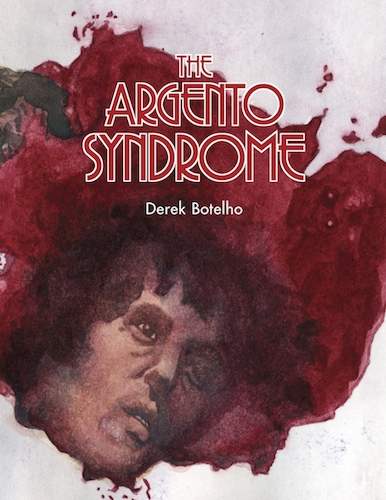
Book Review: The Argento Syndrome

argentosyndrome-scThe Argento Syndrome
By Derek Botelho
Published by BearManor Media, 2014. 261 pages.

Do we really need another book on Dario Argento? I mean, after the great tome from Alan Jones, what more could be said? The answers to those two questions is Yes and a LOT! There are some books that are just fact based, like reading something from IMDB. Or others are just loaded with stories from the authors point of view. But the real beauty of Botelho’s book is that it is a combination of those two types, making it not only a great read, but very informative.

He covers all of Argento’s movies, but also gives us a little story behind it of how he first saw it, which gives the reader an insight to the author, but it also shows that he is a fan, just like most of us. Reading a book on a filmmaker that is basically someone’s college thesis can sometimes be a bit dry, but Botehlo gives us some great stories about the man, the movies, and the different people that worked on them.

Continue reading

Book Review: A Companion to the Horror Film

companionhorrorfilmA Companion to the Horror Film
Edited by Harry Benshoff
Published by John Wiley & Sons Ltd., 2014. 588 pages.

My first thought about this book of collected essays was the cost, retail price of $180. Now, this is a very thick and heavy hardcover book, close to 600 pages, written by a group of people that have Professor or other intellectual monikers before or after their names. But is any book worth that much? Are you going to get that much out of it? Well, right away, Tim Lucus’ Bava book comes to mind and yeah, I do think that is worth the heavy price. Plus the fact that Lucus’ tome is quite a bit larger in size, and is chocked full of amazing color photos. With a price of $180, it is going to take a special collector and fan to afford this volume for their collection. But even if you have the money, is it still worth buying?

For me personally, there were a few things that I found very interesting, such as Aaron Smuts chapter “Cognitive and Philosophical Approaches to Horror”. He discusses what is known as the Paradox of Horror, which is a slight take-off of the Paradox of Tragedy, which asks the question of why we would want to indulge in, like reading or watching something, that is “likely to arouse negative emotions.” He asks the age old question of why horror is popular. But at the end of essay, all he does is recap his and others theories but never answers the question that he posed. But none the less, I enjoyed what he was discussing.

Continue reading

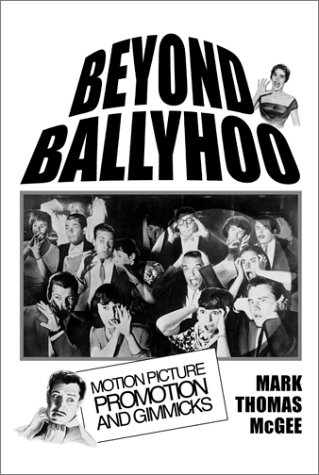
Book Review: Beyond Ballyhoo

Beyond Ballyhoo: Motion Picture Promotion and Gimmicks
By Mark Thomas McGee
Published by McFarland & Company, 1989, republished in 2001. 237 pages.

Beyond Ballyhoo

Beyond Ballyhoo

I’ve always been a sucker for a gimmick when it comes to the movies. It definitely was something for a different era of movie promotions, though there are a few out there that still practice this old way of getting your audience’s attention, but nothing like it used to be. But even though those days are gone for the most part, reading about them is a lot of fun. Sure, it makes you wish you were around during those times. I mean, who wouldn’t have loved getting an “Up Chuck Cup” when going to see I Dismember Mama? Or getting to drink some ‘green blood’ when you went to see Mad Doctor of Blood Island? But it is fun to read about all the different wild and crazy things that studios used to come up with to try and get people to come to see their movies….even if the movie wasn’t that great.

Once again, McGee does an excellent job as our storyteller, giving us not only a lot of facts, but personal references and memories as well, which makes the stories even more entertaining. We get to hear about gimmicks like the coming of sound pictures…yes, that’s right. Sound pictures started out as just another gimmick to get people to the theaters. Then we have the coming all the different types of presentations, like CinemaScope…Dynamation….VistaVision….and the list goes on. Of course, then there is the invention of 3-D movies, and all the different kinds of those! Needless to say, we get to hear about them all in McGee’s well written book that is just packed with information.

And most of all, it is so much fun to read.

Chain Saw Confidential Review

chainsawconfidentialChain Saw Confidential
By Gunnar Hansen
Published by Chronicle Books, 2014. 240 Pages.

Texas Chain Saw Massacre really is a movie of legends. For a low-budget film made by a bunch of youngsters, with more hardships than one could ever imagine, resulting in a truly classic horror film that is astounding that the product was ever even finished. Because of its huge following, over the years there has been several documentaries, pages and pages of retrospectives and articles written about it, with each and every one expanding the legacy that it has so rightly deserved. And I have seen most of those and read quite a lot about this film. I’ve also seen the film more times than I could count. So do we really need another book on the making of this film?

Continue reading