

(1968)
Directed by Satsuo Yamamoto
Starring Kôjirô Hongô, Miyoko Akaza, Kô Nishimura, Mayumi Ogawa, Takashi Shimura, Michiko Ôtsuka
One of the earliest Japanese ghost story films was Botan-dôrô (1910), which was based on one of the oldest and most commonly used themes over the years in rakugo, then kabuki, before moving into the film world. The story actually came from a book of Chinese ghost stories called Jiandeng Xinhua by Qu You, first published in 1378. It was later adapted by Japanese author Asai Ryoi in his book Otogi Boko, giving it a Japanese setting and calling it Botan-dôrô. While there are many variations on the story, it basically deals with doomed lovers. In 1968, it was adapted for the screen by Yoshikata Yoda and directed by Satuso Yamamoto, called Peony Lantern, or The Bride from Hades.
This version of the story has a strong message of fighting traditions, which was something highly frowned upon in Japanese culture, especially the days of feudal Japan, but also shows the darker side of karma, getting what one deserves.

The story begins with Shinzaburô Hagiwara, who comes from a wealthy family, but chooses to spend his days teaching poor children to read and write. His father wants him to marry the wife of his recently deceased brother, which will help the family’s standing, but Shinzaburô refuses. This obviously does not bode well with his family, who then threaten to outcast him.
It also happens to be the first day of the Obon Festival, a time for the remembrance of the dead, but also a time when the dead can return during the three days of the festival. During the festival, Shinzaburô meets up with a young courtesan named Otsuyu and her mistress. He is told that she is to marry an older man that she was assigned to, but doesn’t want to fulfill her duty, much like Shinzaburô with his family. It doesn’t take long for them to fall in love.
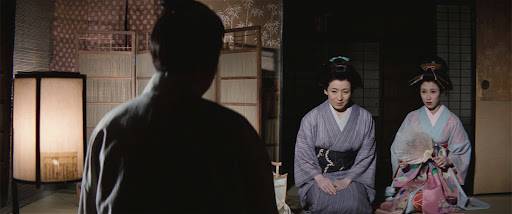
When Shinzaburô’s assistant happens to see the two together, recognizing Otsuyu, he soon finds out that it can’t be her because she is dead. Before she was supposed to be married off to the old man, she killed herself, after which her mistress followed suit. He tries to tell Shinzaburô this, but he won’t believe him. During their next meeting though, he realizes it’s true, but is so far in love with her, he doesn’t care. The villagers can tell that because of this romance Shinzaburô has with Otsuyu, it is slowly killing him and beg for him to stop seeing her. There is only one more night before the end of the Obon Festival, so they have a priest put written spells around all the doors and windows to stop the ghosts from entering. Will this stop them? Or is it the fate that Shinzaburô and Otsuyu wish to have, which is better than what they have now?

One of the things that really blew me away here is not only the love story, but the visuals throughout the film. From the skeletal makeup on the ghosts, to how they seem to float above the ground as they walk without being able to see their legs, to even the change in the color of Shinzaburô’s face the longer he sees Otsuyu. Cinematographer Chikashi Makiura has to get a lot of credit for how this film looks. Especially for 1968, these effects are still highly effective today.

Produced by Daiei Studios, they were one of the other major film studios during the postwar Golden Age of Japanese cinema, next to ones like Toho. Daiei started in 1942, producing films like Akira Kurosawa’s Rashomon (1950), as well as the Gamera series, Zatoichi and Yokai Monsters, and three Daimajin films.
Kôjirô Hongô, who plays our hero Shinzaburô, appeared in many of those Daiei films, including several Gamera films, such as Gamera vs. Barugon (1966), Gamera vs. Gyaos (1967), Gamera vs. Viras (1968), and even in the ’90s reboot, Gamera, Guardian of the Universe (1995). He also appeared in Return of Daimajin (1966), Yokai Monsters: Along with Ghosts (1969), and The Haunted Castle (1969). Kô Nishimura, who plays the mischievous assistant to Shinzaburô, appeared in close to 250 films and TV shows in his career. For the horror genre, he was the hunchback in the highly impressive House of Terrors (1965), as well as Snake Woman’s Curse (1968) and The Living Skeleton (1968). But if that wasn’t impressive enough, actor Takashi Shimura had 343 credits, working since the ’30s. In this film he plays Hakuôdô, one of the locals trying to help Shinzaburô from his deathly fate. But Kaiju fans will know him as Dr. Kyohei Tamane from the original Godzilla (1954) and its first sequel, Godzilla Raids Again (1955). Kind of surprising to see a Toho actor appearing in a film for Daiei, but maybe he just wasn’t under contract at the time.
This film was recently released in an amazing box set called Daiei Gothic, which also had The Snow Woman (1968), both of which had 4K restorations, as well as a high-definition digital transfer of The Ghost of Yotsuyu (1959). I couldn’t recommend this set enough.
 kitleyskrypt.com