
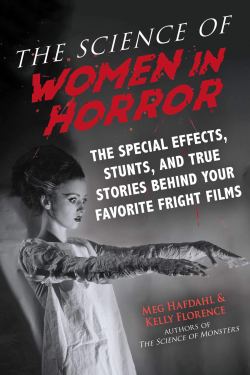
 The Science of Women in Horror: The Special Effects, Stunts, and True Stories Behind Your Favorite Fright Flicks
Published by Skyhorse Publishing, 2020, 247 pages
By Meg Hafdahl & Kelly Florence
The funny thing about this book is that I had no intention of diving into it right away. I saw it on Amazon, I didn’t have it in my library, it was a pretty decent price, so I figured I would order a copy. I was already in the middle of another book so when it came, I just picked it up browse through it quickly before it was put away on the shelf. Then I started reading the intro. Then the first chapter. Next thing I know I’m 25 pages into it!
There are several things that I really enjoyed about this book. The first, which is right in the introduction, authors Hafdahl & Florence remind us all that one of the greatest monster tales of all time was created by a young woman, Mary Shelley. You would think that would have made the road for other female creators to continue that path equally alongside their male counterparts. Unfortunately, we all know that isn’t the case. But this book shows that there are many names out there in the genre that are working very hard and keeping that path open, maybe making it even easier for the next female talent to find and start their journey.
Early on in the book, horror icon Dee Wallace is interviewed, where she states “The Academy and industry as a whole still do not consider the horror genre and the actors therein worthy of awards. It demands some of the highest emotional work in our industry.” This isn’t really about women as much to the genre itself, which I think is something else that is very underrated as well as understated, as to what all genders working in the genre are faced with. Which just goes to show how devoted these people are to continue to do so.
This point was made even more so during the interview with filmmaker Samantha Kolesnik, when she was asked if she felt she was “infiltrating a ‘man’s’ genre” by working in horror. She replied “No. I have never felt as though I were infiltrating because I do not view horror as a ‘man’s’ genre.” She goes on to say that “horror is just as much as ‘my genre’ as it is anyone else’s. At the end of the day, I retain the power to tell my own stories how I see fit.” I just love her response because that is what it should be for everyone, whether your male, female, trans, straight, or whatever. As she says, it is “my genre” too.
The different chapters each cover a specific movie, that all have a female angle, whether it is a female director, a female lead, or some other aspect, but all giving a point for the connection. Some chapters have an interview that might not deal with the movie being covered, but do have a connection or tie in with the one being discussed. I really enjoyed the fact that they give a wide variety of viewpoints and thoughts on the different subjects, which gives the reader much to ponder.
Yes, there were a few things in there that I thought were getting close to Psycho-Babble territory, but honestly I think it was me just being a little too picky. For instance, when discussing the Friday the 13th series, they write it’s about “a vengeful mother who lost her son to drowning because camp counselors where getting frisky. When this son, Jason, is resurrected for the sequels, he finds sex as abhorrent as his mother did. He continually kills teens who are about to have, are in the middle or, or have just finished a sexual encounter.” Maybe Jason, like his mother is just killing counselors. Period. The sex really has nothing to do with it. If you’re a counselor or on the camp grounds, you’re a target.
Or the reason that Sidney in the first Scream film breaks one of the taboos and is allowed to live after having sex, maybe is because the screenwriter wanted to break said taboo, and had nothing really to do with the story itself? Again, I just finished a real crazy overly analytical book on the genre, so I’m just coming down from that!
But on a positive note, there were several times when they would have an opinion on a certain subject, then followed up by an opposing viewpoint. I really liked that they were not being one-sided, but giving both sides fair say. When something is preachy and one-sided, we tend to be more argumentative, instead of thinking about it. Myself included, trust me. But when it is either brought up as an idea, or even better, given an opposing side, it really can make one think a little more about the concept being discussed. I feel that really is key.
This is a very fun book to read, with a lot of different ideas and theories to ponder upon. But the best part is shows that this genre that we all love, is everybody’s to enjoy, create, revel, and participate in. And each one of these voices should be heard, no matter who they are.
 kitleyskrypt.com
Pingback: Women in Horror Book Titles |