
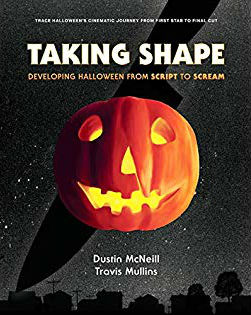
 Taking Shape: Developing Halloween from Script to Scream
Published by Harker Press, 2019. 439 pages.
By Dustin McNeill & Travis Mullins
The Halloween series, as a whole, is not one that I would say I’m a huge fan of. I love the original and really like its sequel. This might have something to do with it playing at the theater I worked at upon the sequel’s initial release, where I would get to see parts of it over and over and over again, seeing its effect on the audience time after time. And yes, I was one of those original haters on Season of the Witch, but have since gotten over that and realize the pure genius of that entry. But from then on, there was never a sequel that I got excited over, or was waiting for its release.
Sacrilege, you say? I just felt the sequels got dumber with each entry. When Rob Zombie took his turn, while I thought the first one was better than the last several, I still didn’t care for it. And I still am confused at the reaction to the latest one, when we saw the re-re-re-return of Jamie Lee Curtis, with fans acting like it was her first return since the 1981 film.
Now you might be asking yourself why am I stating how much I really don’t care for the Halloween series as a whole? Because even with all of that being stated, I devoured this book!
Authors McNeill and Mullins took a very interesting concept here, not doing the usual countless interviews with people involved, throwing theories upon theories, why this happened, why this didn’t happen, and all the usual stuff. What we get instead, is a very simple, yet thorough and detailed comparison of each of the films, from the very beginning of the concept, through the story development, and then the different versions and variations it went through to the finalized released print. But they don’t stop there since we also get to read about what is beyond that with director’s cut and alternate scenes that were used for the television screenings. We get to read about the deleted scenes, as well as scenes that were written but never filmed. What this means is that the fans almost become silent witnesses to the creation of these films, seeing how the story progresses through the different drafts, different screenwriters and what they bring to the final story. That is what I found most fascinating with this book.
It was very interesting to read some of the original story concepts and plotlines of the early drafts of these films. Starting with the direction they were heading, only to be scraped, or a different writer(s) brought in, sometimes starting completely over, or sometimes taking bits and pieces of it and reforming it into something new. And then going through all of that again with a new writer.
I also really enjoyed that while the authors are obviously fans of the series, this is not a puff-piece, praising each and every film. They are very up front and honest with their thoughts on the different entries, but never letting it get into the way of the point they are making. A prime example is the complete mess that is Halloween 6.
The book covers all the films up to and including the 2018 film, with interviews with different screenwriters, directors, editors, cinematographers throughout the series. We even get to hear from some screenwriters whose script was never even used!
If you are a huge fan of the Halloween series, then you probably already have this in your library. But even if you’re not, like myself, but enjoy hearing the stories of how these films come to be, you will find this book fascinating and very engaging. As I said, I don’t even like the later day sequels, but I was intrigued enough to (almost) make me want to go back and revisit them! Okay…I do have a hankering to revisit the original Halloween 2… and Season of the Witch… and maybe Part 4… but that’s IT!
 kitleyskrypt.com